
Building "Money Daily" : Expense Manager
“From scattered expenses to a connected system—see, shape, and control your money as a living web.”
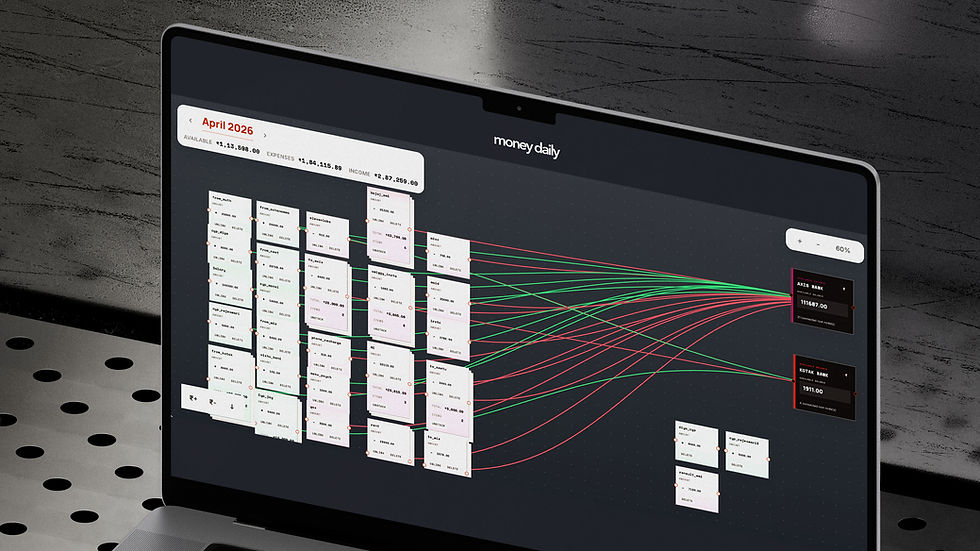
Most expense management apps do the job, but they rarely make the job feel good. They tend to flatten money into dull tables, cramped forms, and screens that feel more like admin work than actual decision-making. With MoneyDaily , the idea was to make expense tracking instantly readable and a little more alive: instead of just listing transactions, we turned money movement into a visual map. Income, bills, and balances sit as connected nodes, so you get a quick summary of what is feeding what, where the money is going, and what is left, almost at a glance.

That node-and-connection model changes the experience in a subtle but important way. It is not just “different for the sake of it”; it gives structure to something people usually understand mentally but rarely see visually. Bank balances become anchors, expenses become branches, and the lines between them make the monthly flow feel obvious. The result is more engaging than a spreadsheet, but also more practical: users can scan, drag, connect, and understand their month in a way that feels closer to sketching a plan than filling out a report.

A big part of the design process was making the interface feel familiar, not abstract. I shaped the nodes to resemble small bills and receipts, used soft paper-like colors, and gave income and expense cards their own tones so the canvas feels readable without becoming noisy. Even the stacked cards hint at the idea of grouped expenses, while the balance nodes feel more solid and “bank-like,” acting as visual bases for the whole system. That helped the app feel playful, but still grounded in real financial objects people already recognize.

I built and refined all of this inside Codex through a series of quick iterations: testing layout ideas, adjusting the node shapes, tightening the visual hierarchy, and simplifying interactions until the canvas felt both clear and approachable. The process was less about one big breakthrough and more about repeated small improvements, making the flow cleaner, the visuals smarter, and the experience less intimidating. In the end, the case for the app is simple: expense tracking does not have to be boring, and when the interface invites people in, they are far more likely to actually use it. MoneyDaily Vibecoded by Mahesh Ravi


Comments